

European assistance to Trump regarding the Strait of Hormuz could become leverage for resuming negotiations on Ukraine.
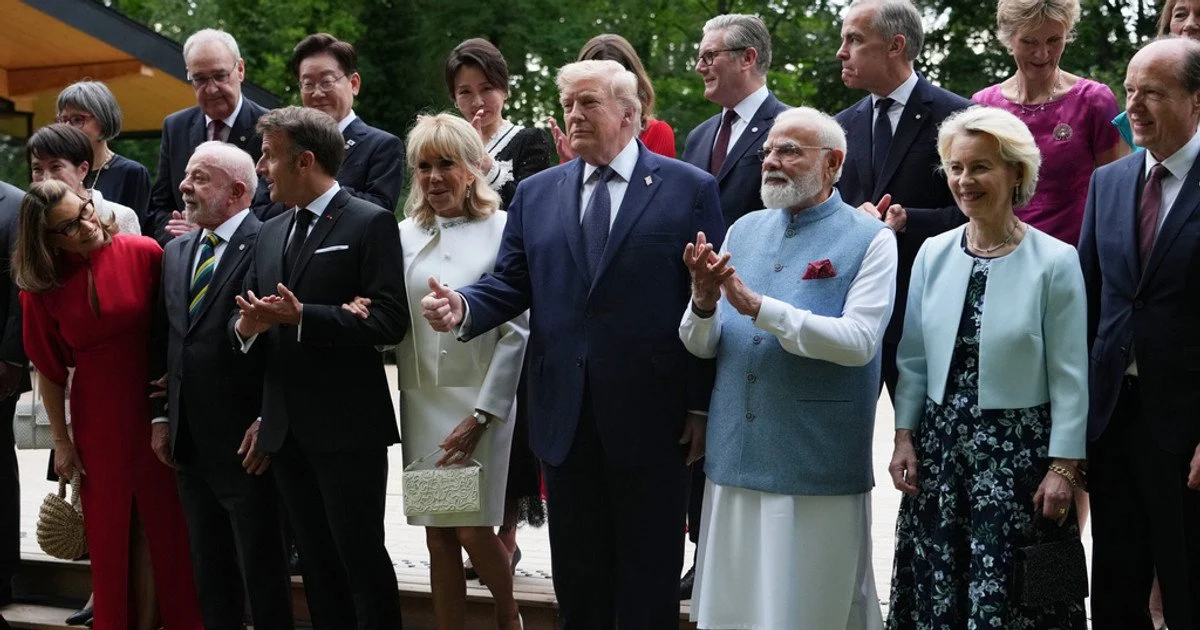
President of the USA Donald Trump and other world leaders at the G7 summit / © Associated Press
G7 leaders have expressed readiness to support US President Donald Trump’s plan regarding Iran and the clearing of the Strait of Hormuz. However, European allies are awaiting clear assurances of the reliability of Washington’s peace deal with Tehran before sending military resources to the region.
This is reported in a Politico article.
Amid questions about the yet-to-be-published US-Iran memorandum of understanding, slated for signing on June 19, French President Emmanuel Macron stated this week his readiness to promptly dispatch fighter jets and frigates. At the same time, he emphasized that the relevant request must come not only from the US but also from Iran and Oman.
A representative from the United Kingdom, in turn, indicated that the country “is ready” to deploy its resources to the region, though without specifying the conditions or timeline for a potential deployment.
German Chancellor Friedrich Merz also made it clear that Berlin could participate in the process, but only if “necessary conditions” are met.
Italian Prime Minister Giorgia Meloni, during a meeting with Middle Eastern leaders on June 16, stated that her country is prepared to continue participating in missions to ensure trade security, as reported by an anonymous Italian diplomat. However, Meloni stressed the need for long-term solutions, particularly concerning Gaza and Lebanon, which could pose a significant obstacle to Trump’s deal with Iran.
Trump asks the EU to help clear the Strait of Hormuz
US officials at the G7 summit this week emphasized international coordination for the swift clearing of the Strait of Hormuz. According to a G7 representative, during a dinner on June 15, Trump “particularly insisted on the opening of the Strait of Hormuz and the necessity of clearing it of mines.”
“I don’t think it’s a bad idea to have one or two ships here from several countries. You would be a great country for this,” Trump said during a bilateral meeting with Macron on June 15.
Europe remains uncertain about the US promise to end the war with Iran
Europe’s cautious stance, however, underscores the continued uncertainty surrounding the Trump administration’s promise to end the war with Iran. The White House has yet to present the full details of the memorandum of understanding, complicating discussions among leaders at the Group of Seven summit.
“Europeans have extensive experience negotiating with Iran. They know how difficult it can be. They know how adept the Iranians are at exploiting any opportunity. And I think they simply don’t want to be left holding the bag. If [Europeans] find a way to take on more responsibility without becoming culpable for an outcome they can’t control, then there’s an opportunity here,” said Suzanne Maloney, a Middle East analyst and director of the Foreign Policy program at the Brookings Institution.
European allies are keen to fully restore shipping in the Strait of Hormuz as soon as possible and return to pre-war levels of transit, but experts acknowledge that the normalization of operations may take weeks while the Trump administration, along with partners, agrees on further steps.
A senior US administration official noted this week that involving G7 countries could be “a very useful thing for returning to normal as quickly as possible.”
Europe may help with the Strait of Hormuz – what Ukraine has to do with it
Some European allies have already expressed their readiness to participate. France and Britain are promoting an initiative to establish a multinational mission to protect shipping and facilitate mine clearance. Meanwhile, British military divers have already begun preparations for relevant operations.
“We have already sent the first mine-clearing ships to the region. We are ready,” stated Merz.
Allies have several motives for supporting the US – primarily economic interest in the rapid opening of the strait. However, it is also an opportunity to improve strained relations after Trump’s criticism, who stated that European partners had not helped Washington enough in military operations, refusing to participate in ensuring the blockade and guarding the Strait of Hormuz.
“I think allies will be interested in helping if it’s in cooperation with Iran… it will allow them to show their contribution to President Trump. It is also a hidden nod to us, as it shows they are helping to rectify the consequences as a responsible party. It is also leverage or an argument that will help them return to the negotiating table for a final agreement, and possibly for negotiations on Ukraine,” said an anonymous former Trump administration official.
Trump also made it clear this week that an agreement with Iran opens up more opportunities for him to focus on the war in Ukraine, as the country urgently needs additional American missiles and is showing successes in the war against Russia for the first time in many years.
The US president also suggested that the US might allow the sanctions waiver on Russian oil, which expires on June 17, to expire, while G7 allies insist on increasing pressure on the Kremlin.
“We will be able to do that soon because oil is already being supplied. We lifted sanctions because, obviously, we didn’t want to interfere with oil supplies, but soon we will be in a position to do that,” Trump said.
Recall that at the G7 summit, Trump expressed readiness to increase pressure on Russia to end the war against Ukraine, but in return, he demands assistance from European allies in ensuring security and clearing the Strait of Hormuz within the framework of US agreements with Iran. Despite previous concerns about conflicts, G7 leaders, through diplomatic efforts, achieved “cautious optimism,” seeking to keep Trump within the Western alliance ahead of the NATO summit in Ankara. However, diplomats warn that the US president’s position could change rapidly.
Comments Sort: New Old Popular Send