

ЗСУ’s battlefield successes and effective drone strikes on Russia have compelled the American establishment to re-evaluate its stance towards Ukraine.
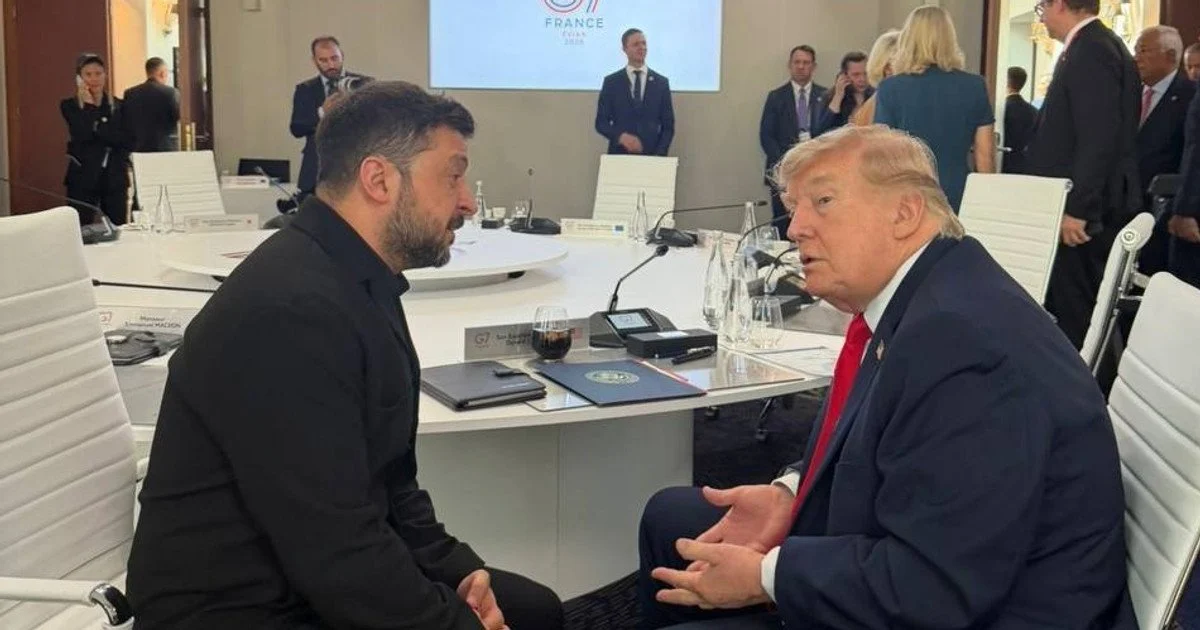
Volodymyr Zelenskyy and Donald Trump / © Volodymyr Zelenskyy
Following a challenging 2025, the administration of US President Donald Trump is showing signs of a genuine shift in its approach to Ukraine. Despite optimistic signals, the main question remains: are Washington ready to translate the change in rhetoric into concrete actions?
This is discussed in an article by Foreign Policy.
USA’s Changing Attitude Towards Ukraine
Trump has long displayed a skeptical attitude towards Ukraine. During an intense meeting with Ukrainian President Volodymyr Zelenskyy in February 2025, he stated that the Ukrainian leader “has no trump cards.” However, this year’s G7 summit demonstrated a different approach. Last week, Trump characterized Russia as the “aggressor” in the war and supported a statement in favor of Ukraine. French President Emmanuel Macron specifically emphasized that the head of the White House is showing a “real change of approach” regarding Ukraine.
It appears that shifts in sentiment are evident not only in Trump himself but also among representatives of his administration. Secretary of State Marco Rubio stressed in May that Ukraine possesses the most powerful army in Europe and also drew attention to the scale of Russian losses.
“The Russians are losing five times more soldiers each month than the Ukrainians,” Rubio stated.
On Thursday, this assessment was echoed by Secretary of Defense Pete Hegset: “The Ukrainians are holding their ground despite constant Russian assaults.”
Why Has the US Changed Its Attitude Towards Ukraine?
Ostap Yarysh, a media advisor for the Ukrainian public organization “Razom dlya Ukrayiny” (Together for Ukraine), attributed this change, in part, to the state’s successful actions on the front lines – primarily due to the use of medium and long-range drones.
According to Yarysh, these attacks have seriously undermined Russia’s image as an untouchable and protected state, while simultaneously generating resonant footage of destruction in Moscow and St. Petersburg. One such strike caused thick black plumes of smoke visible even from the vicinity of a prestigious economic forum attended by Russian President Vladimir Putin.
“They are very visual, so I think it impacts public perception. Ukraine’s effective strikes speak louder and more convincingly than any Russian propaganda,” Yarysh explained.
Consolidation of Support for Ukraine Among Trump’s Supporters
Meanwhile, among Trump’s influential supporters, a growing consolidation of support for Ukraine is also becoming more apparent, although it is still difficult to assess the significance of this influence within the US government.
In recent weeks, ultra-conservative influencer Laura Loomer has published a series of pro-Ukrainian and anti-Russian posts on social media. This was partly a reaction to the trip to Russia by another ultra-right influencer, Candace Owens.
Loomer previously had some influence in the White House due to her connections with Trump and was involved in personnel changes at the National Security Council at the beginning of his presidency.
Meghan McCain, daughter of former Trump envoy to Ukraine Keith Kellogg and a well-known conservative supporter of Ukraine, emphasized that the US President’s political base is open to further engagement.
“They are quite open to persuasion – but no one is really working with them,” she said.
An event focused on Russia, organized on June 10 by the Independent Women’s Forum, where McCain holds a directorial position, brought together analysts from leading American think tanks and representatives of the MAGA movement. Among the participants were representatives from PragerU, as well as Kash Patel’s partner, Alexis Wilkins, who claimed to be a target of a Russian disinformation campaign.
However, the question of whether this change in rhetoric will translate into practical decisions remains open.
US Rhetorical Shift on Ukraine May Not Lead to Concrete Actions
Ukraine continues to insist on additional missiles for its MIM-104 Patriot air defense systems, as well as the reintroduction of comprehensive US sanctions against the Russian oil sector, some of which the US temporarily eased due to global oil market instability amid the war with Iran. So far, the Trump administration has not announced new deliveries of Patriot missiles.
Meanwhile, last week, the US Treasury Department did not extend an exemption that temporarily eased certain sanctions on Russian energy. However, it remains unclear whether this indicates a return to the previous sanctions strategy.
Supporters of Ukraine have repeatedly witnessed similar shifts in Washington’s rhetoric that later did not translate into concrete actions.
For instance, in September 2025, after a meeting with Zelenskyy, Trump stated that Kyiv could “get back all of Ukraine as it was originally.” Vice President J.D. Vance later publicly spoke about the possibility of transferring long-range Tomahawk cruise missiles to Ukraine. However, after another conversation with Russian President Vladimir Putin, the American leader backed away from these intentions.
Although the White House is gradually demonstrating a more favorable position towards Ukraine, it traditionally avoids harsh statements in its policy towards Moscow. This restraint in rhetoric may indicate an unwillingness to excessively increase pressure on Russia.
A European official recounted approaching the White House with a call to publicly condemn Russia in response to one of its actions in the war against Ukraine. According to him, Washington refused to take such a step, arguing that such a statement could negatively impact the peace process managed by the US.
Another European official also confirmed that White House representatives had made it clear in private conversations that they were not prepared to openly criticize Russia, so as not to jeopardize the negotiation process.
However, lower-level officials have recently become noticeably harsher in their assessments of Moscow’s actions. On June 8, a high-ranking US representative to the UN openly condemned Russian attacks on Ukraine, characterizing the war as a “strategic catastrophe” for Moscow.
And on June 15, the US Embassy in Kyiv reacted sharply to a Russian strike on the Kyiv-Pechersk Lavra, calling the attack “unacceptable.”
However, signals from Washington remain ambiguous.
After a Russian drone hit a residential building in Romania near the Ukrainian border in May, injuring two citizens of a NATO member state, the US Ambassador to the Alliance wrote on X that the US “will defend every inch of NATO territory” – but did not specify from whom.
On Wednesday, the same day the G7 leaders issued a statement of “unwavering support for Ukraine,” Trump avoided a direct answer to the question of who bears more responsibility for the war.
“I don’t want to comment on that because I’m trying to end it,” he said.
Incidentally, the US at the UN called on Russia to immediately agree to peace negotiations, emphasizing that time is not on Moscow’s side. American representative Dan Negrea confirmed support for Ukraine, condemned attacks on civilian infrastructure, pointed to critical losses of the Russian army – about 40,000 personnel monthly – and the deterioration of the Russian economy. Washington stressed that the only way to end the war is through diplomacy, therefore urging the parties to reach an agreement on a complete ceasefire as soon as possible.
Comments Sort: New Old Popular Send