

A perceived shift in the Iran war from a military conflict to an economic one has seen the oil price and Treasury yields dive and shares rise.
And one of Australia’s largest private credit investment managers has limited redemptions on its $2.3 billion secured property loan fund.
Follow the day’s financial news and insights from our specialist business reporters on our live blog.
Disclaimer: this blog is not intended as investment advice.
Live updates
Market snapshot
SPI 200: +0.3% to 9,142.00 points
Australian dollar: +0.2% at 71.6 US cents
Wall Street: Dow Jones (+0.3%), S&P 500 (+0.3%), Nasdaq Composite (+0.6%)
Europe: FTSE (+0.2%), DAX (+0.6%)
Asia: Hang Seng (FLAT), Nikkei (+0.5%)
Spot gold: +0.2% at $US4,661/ounce
Oil (Brent futures): -5.9% to $US86.69/barrel
Iron ore: +0.1% to $US95.40/tonne
Bitcoin: -0.5% to $US78,594
Prices current around 6:45am AEST
Updates on the major ASX indices:
Oil price dives as traders see shift in conflict
The price of global benchmark Brent crude was down as much as 6% earlier today.
Traders appear to have shrugged off the latest US sanctions campaign against Iran, viewing economic pressure less risky for oil supplies than a military escalation.
The shift from military conflict to economic pressure in the U.S.-Israeli war with Iran has reduced some of the oil market’s anxiety, according to Saxo Bank head of commodity strategy Ole Hansen.
He added that the US sanctions announcement was not as forceful as some traders had expected.
Treasury Secretary Scott Bessent unveiled the measures on Monday, almost six months into the war. He declined to identify countries targeted or say when penalties would take effect, adding he would give countries time to comply.
The economic pressure campaign has revived expectations of talks between the US and Iran to resolve their conflict, which began when the US and Israel launched military strikes on Tehran at the end of February.
Reporting with Reuters
Canada announces retaliatory tariffs
Overnight Canada announced retaliatory tariffs against the United States, matching “dollar for dollar” the 50% duties that US President Dinald Trump imposed over the weekend.
Ottawa’s new tariffs include more than 700 US goods, worth about $20 billion.
The counter tariffs range from 15% to 50% and target a wide array of Canadian imports from the US, including dairy, seafood, appliances, wood and paper products, and clothes.
“The recently threatened 50% tariffs on Canadian autos, trucks, and car parts would feed through to consumer prices more readily than before. Automakers and car dealerships have managed to absorb the lion’s share of the tariff costs, but that cushion is wearing thin,” Oxford Economics wrote in a note.
“The timing of the vehicle tariffs suggests that the midterms are a constraint on the Trump administration’s trade policy. But after November, the president may feel unfettered by domestic politics and pursue more trade protectionism, adding upside risk to our forecast for steady disinflation this year.”
CPI ahead along with Woolworths results
Here’s your morning note from the economics desk at the National Australia Bank:
- Oil falls 4% amid hope of US-Iran de-escalation and as Iran, Oman discuss Hormuz pathway
- Energy price drop helps yields lower, led by UK, Europe and softer US economic data
- Equities rose, but pared best of gains as softer US data rolled in; USD can’t sustain early gains
- Ahead today: AUS: Aug CPI, Westpac Leading Index, Construction Work Done, JP: Jul PPI, US: Jul Core PCE, Q2 GDP 2ndrelease, Jul Durable Goods
Private credit redemptions hit Australia
Australia is now seeing private credit redemption limits.
These redemption limits are imposed by large investment firms that become anxious about the amount of money investors begin to redeem from their funds.
This morning we’re learning that MA Financial has announced a temporary redemption limit of up to 1% of its funds under management per month.
This is the first of its kind in Australia.
Wall Street is ground zero for the alternative investment market and there are fears this massive, risky US private lending ship is sinking and investors are jumping out.
Australia’s corporate cop has highlighted unique risks for Australia too.
“If the Australian property is overvalued, and we see those practices emerging and it happens at scale, you get gaps,” ASIC commissioner Simone Constant told The Business earlier this year.
“And when you get those gaps, you get problems with liquidity, you get lagging in data, you get the risk of default, for example.
“And of course, investors putting their money into things that don’t stack up.”
MA Financial’s joint chief executive, Chris Wyke, told Nine newspapers the action was “proactive measure in response to the potential for increased redemption activity”.
“The temporary arrangements reflect the broader market, including uncertainty following proposed tax changes in the federal budget and recent publicity concerning other, unrelated private credit managers,” he said.
MA Financial imposes redemption limits
MA Financial has become another Australian private credit investment manager to limit the investment returns investors can receive.
Private credit is lending outside the banking sector.
It’s hit major hurdles in the US as lending to big tech software companies has soured with the boom in AI.
Major US private credit firms began imposing redemptions of clients last year as investments on those firms soured.
Now Australia is seeing private credit investment redemptions sour.
Here is the ASX release from MA Financial-exposed, and ASX-listed, MA Credit Trust.
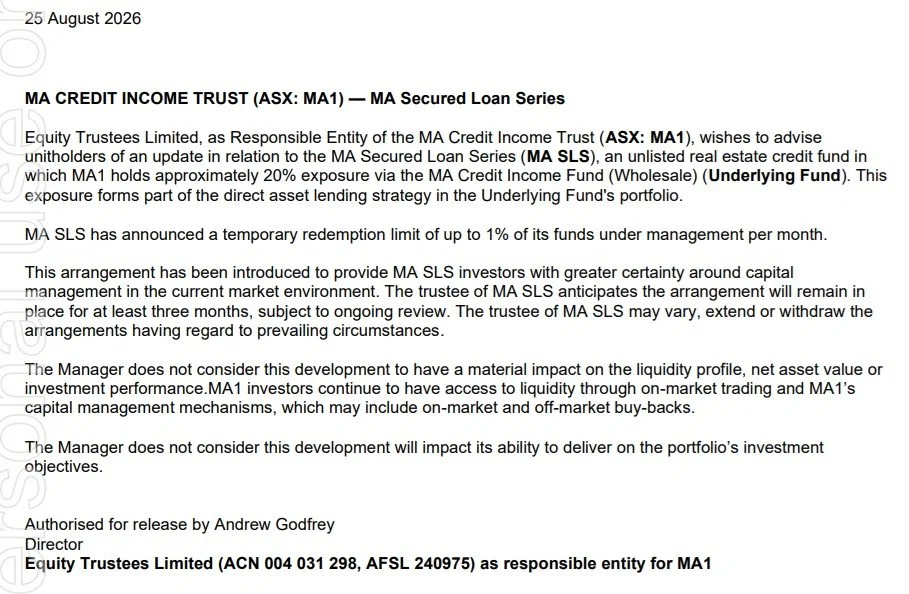
The private credit firm has limited redemptions on its $2.3 billion secured property loan fund in response to “current market conditions and elevated redemption activity”.
The redemption limit will be in place until at least October 31 and will be subject to ongoing review.
MA Financial said the fund had $95 million of cash, or 4.1% of assets, which is below its 5% target.
Treasury yields fall as oil slumps
Morning folks,
David Taylor here to take you through the morning in business and finance.
The main macro event overnight was Treasury yields falling for a second straight day.
The US 10-Year Treasury bond was down 0.08% or 8 basis points to $4.62%.
Yields fell on Monday after the US Treasury Department said it could use its $1 trillion General Account to fund bond repurchases.
Yields took another leg down overnight as the price of oil slumped, taking away an inflation pressure point.
These moves also saw shares rise. Gold achieved modest gains and risk-on sentiment saw the Australian dollar rally a touch.
There’s plenty on today, so stay with me.
Timeline
-
Market snapshot
Pinned
Wed 26 Aug 2026 at 6:43am
-
Oil price dives as traders see shift in conflict
Key Event
Wed 26 Aug 2026 at 8:00am
-
Canada announces retaliatory tariffs
Key Event
Wed 26 Aug 2026 at 7:50am
-
CPI ahead along with Woolworths results
Key Event
Wed 26 Aug 2026 at 7:40am
-
Private credit redemptions hit Australia
Key Event
Wed 26 Aug 2026 at 7:30am
-
MA Financial imposes redemption limits
Wed 26 Aug 2026 at 7:16am
-
Treasury yields fall as oil slumps
Wed 26 Aug 2026 at 6:50am
Top Stories
-
Dolly Parton dies aged 80: Her legacy proves once and for all, ‘this dumb blonde ain’t nobody’s fool’
Topic:Music

-
‘World feels less sparkly’: Dolly Parton’s legacy remembered
LIVE
-
Internal emails expose scale of Anthropic’s Australian AI plans
Topic:AI
-
Here’s why America’s debt binge should worry Australians
Topic:Explainer
-
Why automation and repression go hand in hand
Analysis by Gareth Hutchens
Just In
-
Imperfect lychees go from shed floor to liquor shelf as growers diversify
Topic:Horticulture
Wed 26 Aug 2026 at 7:29am
-
One of WA’s top realtors disqualified from awards over sales inaccuracies
Topic:Real Estate Industry
Wed 26 Aug 2026 at 7:22am
-
Taylor renews calls for Labor MP facing fresh bail charges to be stood down
LIVE
Wed 26 Aug 2026 at 7:34am
-
Private credit fund redemption limits hit Australia
LIVE
Wed 26 Aug 2026 at 7:36am